
Chocolate quality: Using physical characterisation to solve industry challenges
20 March 2026 | Elena Sharma, Food and Drink Science Team Lead
Volatile cocoa prices and supply chain disruption are putting pressure on chocolate manufacturers, driving a need for more efficient processing, careful ingredient selection, minimising waste, and robust quality management.
Chocolate is one of the world’s most popular, but also technically demanding, foods. Its quality is shaped by subtle interactions between ingredients, processing and storage conditions. Maintaining consistent product quality, managing alternative fats and optimising formulations are critical.
This all makes the ability to fully understand chocolate’s physical behaviour – and how it changes during processing and storage – more important than ever.
We work closely with manufacturers to understand these complexities and help them tackle issues ranging from tempering problems and fat bloom to ingredient interactions and shelf-life stability. In this blog, we look at how our physical characterisation tools allow us to profile chocolate in detail and provide clients with insights that directly inform their formulation, processing and product performance.
Measuring polymorph stability and tempering
Cocoa butter and many cocoa butter replacements form different crystal polymorphs, each with their own melting behaviour and stability. Differential scanning calorimetry (DSC) can be used to measure these thermal transitions (thermal analysis), and is therefore one of the most powerful tools we use to assess chocolate quality.
This thermal analysis enables us to evaluate:
- Thermal stability of polymorphs, which is closely linked to correct tempering;
- Differences between cocoa butter and alternative fats;
- Solid fat content (important for predicting fat migration, bloom development, and overall texture).
DSC is particularly valuable for troubleshooting tempering inconsistencies or processing challenges, and for assessing filled chocolates (where fat migration between layers can lead to instability and visual defects). We can also detect the presence of polymorph VI (βVI), which is often associated with fat bloom, making DSC a key part of shelf-life and quality studies.
Mapping composition, structure characterisation and changes over time
Product / ingredient characterisation, compositional mapping and understanding changes over time are all of enormous value when pre-empting, investigating and dealing with quality issues and progressing product development.
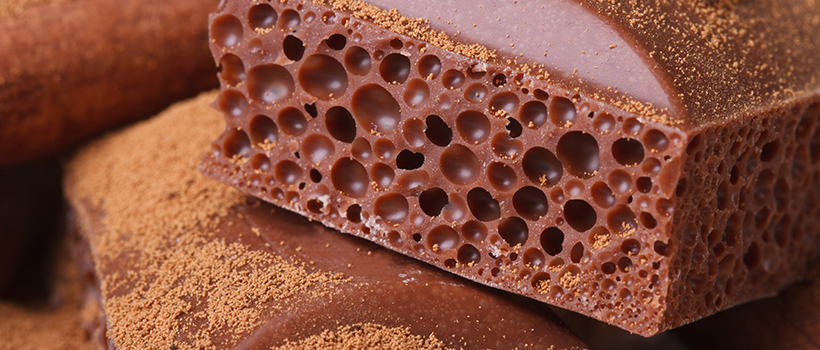
Hyperspectral imaging allows us to capture chemical and compositional information across a chocolate product. X ray micro CT enables us to measure the structure of porous products, including delicate internal structures such as the small bubbles in aerated chocolate. Standard high definition cameras allow observation and quantification of visual changes in colour, bloom or gloss.
By combining these technologies, we can:
- Map ingredient distribution (such as fat, sugar or moisture);
- Detect changes in formulation or structure;
- Observe chemical or physical changes during storage;
- Monitor bloom development or moisture related defects.
Through visualising the distribution of moisture, fat, protein or sugar across a product’s cross section, non-uniformities (which can affect texture, taste and appearance) can be identified for addressing. Tracking moisture migration (or migration of other components, e.g. between layers of filled chocolates) within a product over time can help predict the onset of product quality issues and identify needs for changes storage conditions or packaging.
These techniques are non-destructive and particularly useful for complex or filled products where internal changes may not be immediately visible.
Shelf-life and storage studies
Many chocolate issues arise not during manufacturing, but in the supply chain or even in a consumer’s home.
Our controlled temperature storage cabinets allow us to simulate a wide variety of real world conditions, including:
- Stable storage at controlled temperatures;
- Cyclic temperature changes to mimic transport and retail conditions;
- Accelerated fat blooming;
- Long term shelf life studies.
These tests help manufacturers understand how formulation and packaging choices influence quality, and how issues like fat bloom, texture change or flavour degradation may develop over time.
Rheology, appearance and sensory – completing the quality picture
Understanding the rheological properties of chocolate components is important in determining their texture, as well as how they behave physically when subjected to physical forces and forced to flow. We support clients with comprehensive rheological analysis, measuring mechanical properties such as viscosity and thixotropy as a function of temperature. For chocolate production, these measurements are essential for understanding key behaviours such as coating, moulding, and enrobing, and for optimising production efficiency.
To complement physical and chemical analysis, we provide appearance (colour and gloss) assessment, texture measurement and sensory evaluation, including for attributes such as mouthfeel and melt rate. This combined approach ensures that product performance aligns with consumer expectations as well as technical specifications.
Helping the industry understand, improve and protect chocolate quality
We work closely with manufacturers to understand the technical complexities and challenges of their ingredients and products, and help them to prevent, investigate and tackle all manner of quality issues.
Our suite of physical characterisation tools allows us to profile chocolate in detail and provide insights that directly inform formulation, processing and product performance.
Whether manufacturers are developing a new product, replacing ingredients, optimising processing or investigating shelf life concerns, our chocolate characterisation capabilities help uncover the root causes of quality issues and support robust, science led decision making.
Download our FREE Product Optimisation eBook today! An effective way to unlock elusive value and potential from your products

Chocolate quality
If you’d like to find out more about using physical characterisation to solve your chocolate challenges, get in touch.
Turn complex thermal data into clear, actionable guidance
Understanding how food materials behave when heated or cooled is essential for developing safe, stable, high-quality products.