
Cultivated meat: Towards real-world food production
11 February 2026 | Sarah Overy, Senior Product Technologist
Cultivated meat products offer the potential to provide an alternative, complementary method to traditional meat farming, to keep up with the growing global population and food / protein demand.
Given that current food production practices, limited land and finite water resources restrict the capacity for traditional meat production, cultivated meat has the potential to replace some of the requirements for traditional meat. This is based on its theoretical use of fewer resources, particularly land and water.
The cultivated meat industry is still at an early stage, whereby scaling up the production technology is a key challenge (alongside cost, regulatory, consumer acceptance and product formulation hurdles). To date, much of the research and development has been at laboratory scale, but increasing developments look set to move cultivated meat into becoming a major area of innovation in the food industry itself.
What is cellular agriculture and cultivated meat
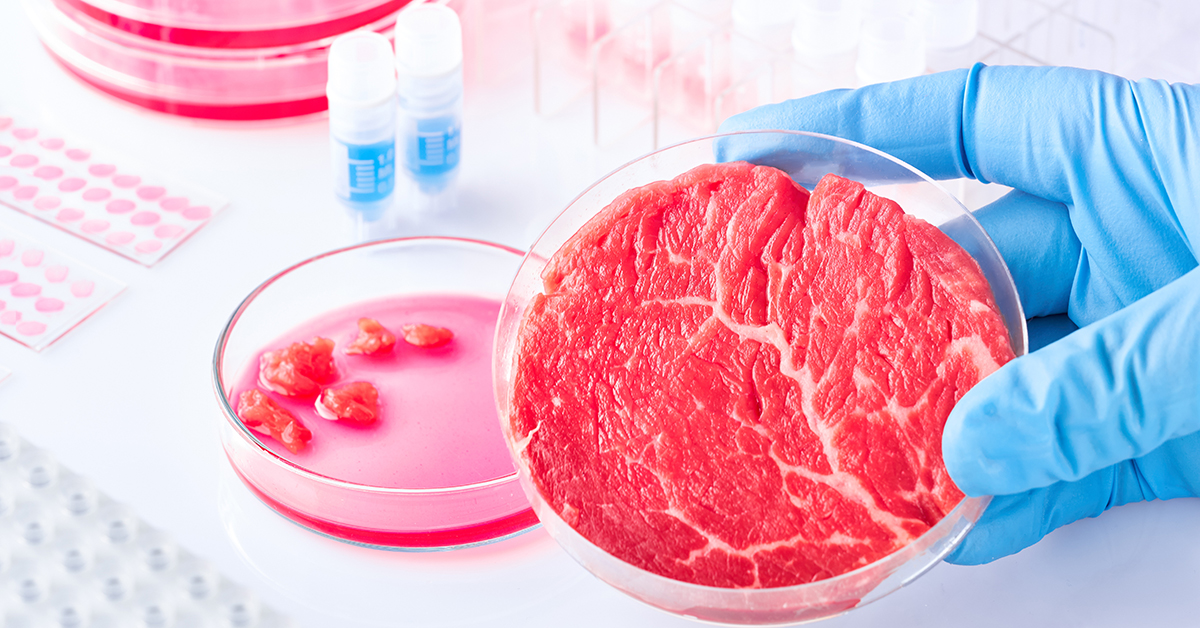
Cellular agriculture is the use of cell culture (cultivating cells in a controlled environment, such as a laboratory or bioreactor) techniques to produce ingredients and food products. One of the theoretically endless possibilities of products that could be produced by this method is cultivated meat, which is made by propagating animal cells in a bioreactor.
An outline of the overall process is as follows:
Small biopsy of cells taken from animal
Cells of interest isolated and stored as a cell line
Cells grown in a bioreactor with nutrients
Cell mass harvested
Product formulation
The cultivated meat industry is at the stage where processes are being tested and validated, but scaling up the technology at a practical cost is a key challenge. That’s where our recent Innovate UK funded project with Cellular Agriculture Ltd comes in.
The scale-up challenge: Innovate UK project with Cellular Agriculture Ltd
Cellular Agriculture Ltd are a UK-based tech company developing next generation hollow-fibre bioreactor (HFB) technology to enable low-cost, low-emission cultivated meat production at scale. We partnered with Cellular Agriculture Ltd, through Innovate UK funding, on a project focused on development of their novel HFB design – to evaluate the scalability of this technology, identify food safety risks, and assess its environmental impact compared to both conventional meat production and other cultivated meat technologies.
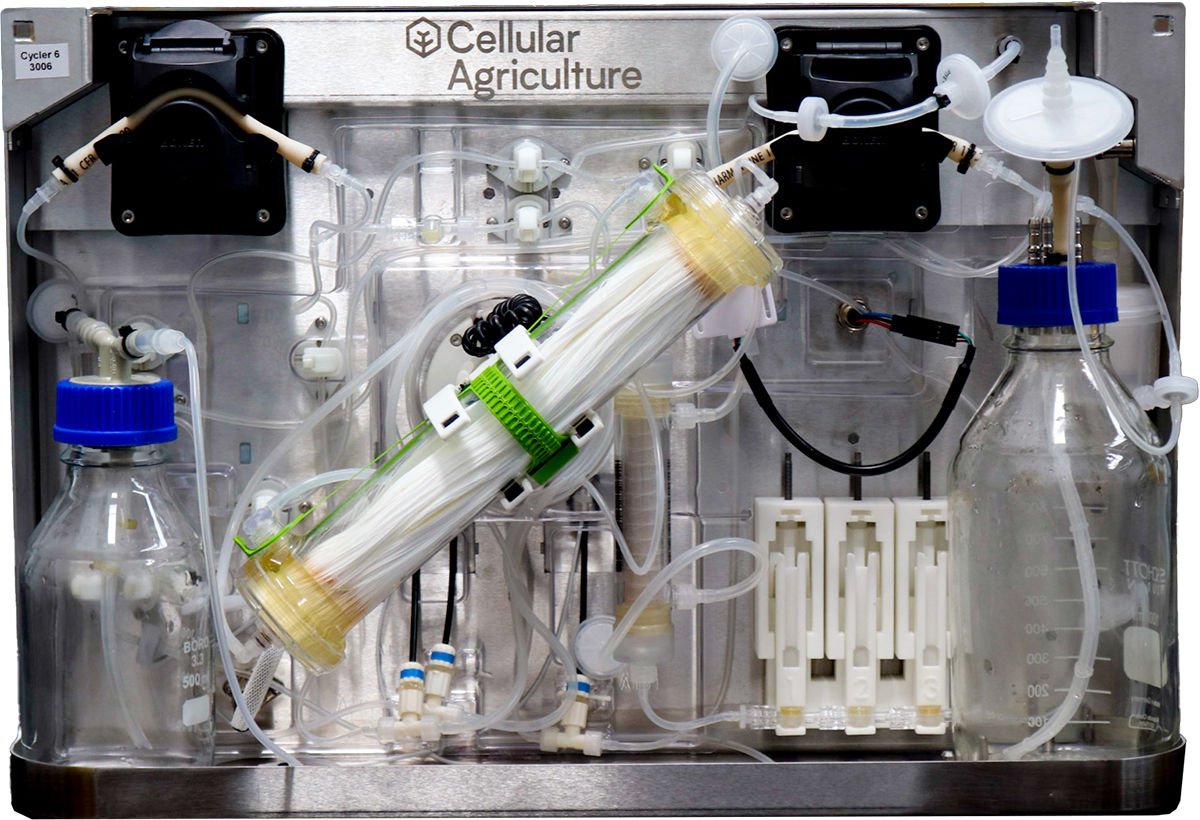
© Benchtop Hollow Fibre Bioreactor System, Cellular Agriculture Ltd.
We tested prototype equipment from Cellular Agriculture Ltd in our new cell culture lab facilities. In this collaboration, we were responsible for testing the prototype and providing feedback to help build an understanding of the optimisation required to develop technology that can produce cultivated meat that is safe, compliant, scalable and ready for real-world food production.
We brought our food industry expertise to the project to offer support in food safety and regulatory considerations for scaling / applying the technology, as well as conducting nutritional and functional analysis of the cell mass.
The project succeeded in the development, testing and validation of a novel, commercially viable production platform for cell cultivated meat production. This proof-of-concept reactor helps to prove the scalability of the technology.
Navigating other challenges for cultivated meat
Alongside the hurdle of production scale-up are regulatory, food safety, consumer acceptance and product formulation challenges.
In some countries, regulatory frameworks have been established to support the commercialisation of cell-cultivated products such as cultivated meat. Other countries have not yet done so, and others have even enforced bans.
When it comes to food safety, due to the novel nature of the product and its production method, a thorough safety assessment would be necessary before products could be brought to market. Hazards must be considered in all stages of the production process.
For the sensory attributes, much can be taken from what has already been learnt from the development of plant-based meat alternatives – consumers will not sacrifice taste / texture and, similar to the need to understand plant protein functionality within plant-based products, it will be important for cultivated meat product development to characterise and influence the similarities and differences (especially in structure) compared to traditional meat products. Where there are problematic differences, other ingredients may be needed to bridge these gaps.
Get involved – we are here to support innovators and manufacturers
To cultivated meat projects, we can bring our unique combination of knowledge in food innovation, process engineering, food safety, nutritional and microbiological analysis, and regulatory frameworks.
Through the project completed with Cellular Agriculture Ltd, we have gained a great deal of knowledge in cell culture and cultivated meat, which is complemented by our new laboratory facility for cultivating meat with prototype equipment. We can also draw on our knowledge from other food sectors to conduct functionality testing and product development of cultivated meat products.
Our team can help food manufacturers to de-risk their scaling efforts by supporting their upskilling in cultivated meat, considering not only the technology but also food safety, regulatory and cost factors.
The technology developed through Cellular Agriculture Ltd’s collaboration with us has the potential to transform the cultivated meat industry by providing a scalable, sustainable solution that addresses existing production challenges. To continue this journey, we invite innovators and manufacturers to get involved – we are keen to collaborate and understand your specific needs.
We can work with you towards making your cultivated meat innovations ready for real-world food production. Get in touch to find out more.

About Sarah Overy
Sarah joined Campden BRI in July 2019 as a product technologist after graduating from the University of Nottingham with a degree in Nutrition and Food Science (with Industrial Placement Year). For Sarah’s industrial placement she spent a year working in product development at Müller UK in the branded chilled dairy desserts team, working on projects from brief to launch.
In Sarah’s final year at university her dissertation investigated the addition of fibre to a non-alcoholic beer product in a lab based project. She was also involved in a group project, entering the Ecotrophelia UK competition to present a new eco based gummy sweet product and business concept to a panel at Campden Day in a dragon’s den style pitch.
Sarah works in the Product Innovation team in the Food Manufacturing Technologies department, which involves delivering pilot-scale development combined with a new product development approach. With over 3000m2 of pilot plant to use, this can encompass a wide range of product types and manufacturing techniques.
How can we help?
Get in touch to find out more about cultivated meat opportunities with us.
Food and drink quality and innovation
Find out more about our expert support for NPD, product/ingredient characterisation and quality, and R&D.