
Can you create a ‘clean label’ product using additives? – Regulatory guidance and practical strategies for EU and UK
13 April 2026 | Helen French, Regulatory Affairs Manager and Training Coordinator, and Lewis Wallis, Regulatory and Nutrition Affairs Advisor
As consumer demand for ‘clean label’ products grows, particularly in the context of debate surrounding ultra-processed foods, food businesses are increasingly seeking ways to simplify ingredient lists by reducing the use of ‘chemical-sounding’ additives or ingredients typically of exclusive industrial use.
However, additives play a vital role in delivering safe, high-quality foods, provided they are used transparently, responsibly and in compliance with legislation. While other ingredients may be important for delivering the sensory qualities that customers have come to expect.
In this blog, we discuss potential consumer understanding of what a ‘clean label’ is and how to navigate the demand for ‘clean label’ products in today’s environment of rising food costs and the constant drive for innovation in the food industry.
Consumer perception
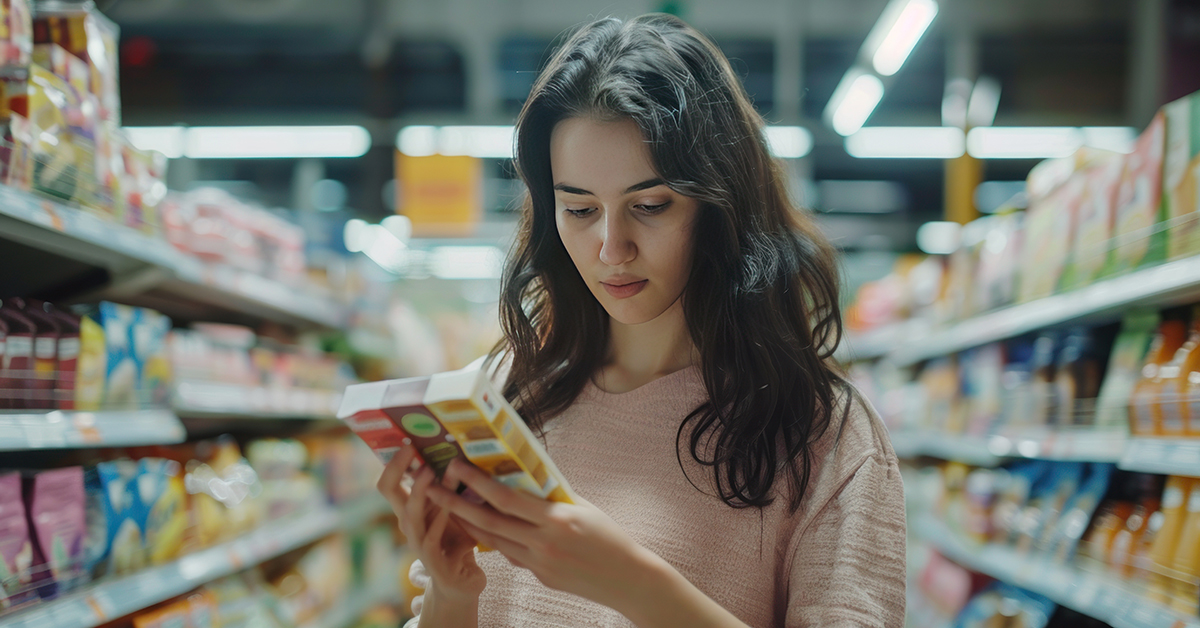
There is no formal regulatory definition of ‘clean label’; it is a consumer-driven concept shaped by perceptions rather than law. Consumers have come to expect shorter ingredient lists with familiar names; ingredients they might have in their food cupboard and use at home. Technical or ‘chemical-sounding’ names, such as those of additives, are often viewed negatively, despite the authorisation process that all additives are subject to in the EU and in Great Britain (GB) to ensure they are safe for use.
Many shoppers associate ‘clean label’ with the absence of colours and preservatives, for instance, which may even extend to the addition of flavourings. Therefore, clear, honest labelling is key. Some aspects of ‘clean label’ overlap with ultra-processed food (UPF) considerations, and it is worth factoring this in when developing or reformulating products. Others may equate ‘clean’ with ‘natural’, organic or minimally processed foods.
Ultimately, consumers want to know what is in their food, where it comes from, and trust the information provided on product labels.
Regulatory framework for using additives
Additives are substances added for a technological purpose (e.g. preservation, colour, texture) and are strictly regulated in the EU and GB. Their use must be justified, authorised, and clearly declared. Only additives authorised for specific product categories may be used and each additive must comply with maximum levels, restrictions, and labelling requirements as set out in Regulation (EC) No 1333/2008 on food additives in the EU, and the assimilated version in GB. Additives must be listed by their functional class (e.g. preservative), followed by their specific name or E number.
When thinking about manufacturing a ‘clean label’ product, it may be tempting to choose additives with familiar names or those derived from natural sources. But, substances marketed as ‘natural’ alternatives such as plant extracts could still be considered additives if they are used for a technological purpose.
Any additives used must be authorised before use, meet the specification listed in the legislation for that particular additive, and be labelled as above.
Strategies for ‘clean label’ formulation with additives
The use of additives is essential for many products in terms of safety and quality. Therefore, it may be preferred to use additives with consumer-friendly names, such as ‘ascorbic acid’ or ‘bicarbonate of soda’, instead of using their E numbers. But would these products be considered as ‘clean label’ when they contain additives? – it’s difficult to say because there is no legal definition of ‘clean label’.
The use of food ingredients (e.g. vinegar, lemon juice) that perform the same function as additives but are exempt from additive status may satisfy the need for ‘clean label’ to the consumer, even though their presence is performing a technological purpose.
‘Clean label’ products could be perceived as ‘healthier’, which is why being transparent about the presence of additives is paramount, using plain language when providing information on the ingredients contained within the product, and educating the consumers about the purpose and safety of each additive.
‘Clean label’ approaches in practice
Any ingredient/substance intended as a ‘clean label’ or ‘natural’ alternative to a food additive would still be in scope of the above legislation if it falls under the legislation’s definition of a food additive and does not meet any of its listed exemptions.
It isn’t necessarily what the substance is that determines whether additives legislation is relevant, but rather what the function of the substance is. As can be seen from the following examples of, and considerations for, ‘clean label’ approaches in practice.
- Buffered vinegar: - Authorised as an additive in the EU in 2023, buffered vinegar can be used as a preservative. When used, it must be declared as an additive (E 267) and meet all specification requirements. Its familiar name (‘buffered vinegar’) can support ‘clean label’ positioning if used transparently. It is not currently authorised as an additive in GB.
- Colouring foods vs. food colours: - Using whole foods such as beetroot, carrot and saffron for colour may be exempt from additive status, provided no selective extraction is involved. If pigments are extracted, the resulting ingredient is a colour additive and must be declared as such.
- Plant extracts and fibres: - Substances like bamboo fibre or rice hull powder have received interest for use as ‘clean label’ anticaking agents. If intended for use for a technological function (such as anticaking or other function), they are considered additives and would require authorisation in the EU and GB.
Key takeaways for clean label success
If you use additives in your products, ensure they are authorised for your product and used within legal limits. Authorisation in the EU does not automatically apply in GB, therefore it is important to monitor updates to the authorised additives list in both the EU (by consulting the consolidated version of Regulation (EC) No 1333/2008 on food additives) and GB (via the FSA register of regulated products in GB).
When considering marketing your product as ‘clean label’, choosing ingredients that are familiar and acceptable to your target market may be one option, ensuring that formulations and labels align with evolving regulations and consumer expectations.
Need help?
Our Regulatory Affairs team can support you in offering formulation reviews (including for individual additives) for regulatory and safety aspects, label checks and up-to-date regulatory advice.
You can also keep up to date with the latest developments through Food Law Alert; a Campden BRI Member benefit providing prompt and succinct news of developments in UK and EU food law, every fortnight.
This support is part of our valuable, extensive and authoritative information and advisory service to help clients stay compliant with food regulations in more than 80 countries. Whatever the legislative requirements of your target market, our experienced team of regulatory experts will ensure your products are compliant.
Contact us or browse our Global regulatory support services.

About Helen French
Helen has been working in the food and drink industry since 1990 and has a wealth of knowledge and experience from working in food manufacturing, at a flavour house, as a consultant, and here at Campden BRI (where Helen has been since 2013).
Regulatory and safety aspects of ‘clean label’ additives
Get in touch for formulation reviews, label checks, and up-to-date regulatory advice.
Safe, successful and cost-effective products
We provide expert support with NPD, product/ingredient characterisation and quality, and R&D.