


HACCP: Six key elements of an effective HACCP system
24 April 2026 | Andrew Collins, Global Safety Lead
Risks are always emerging and changing in the food industry, and so therefore are standards, guidelines and codes of practice. Keeping pace with the latest developments in food safety management (including HACCP) is paramount to protect your business, products and consumers.
Guideline 42 sixth edition is strongly grounded in the recent updates of the General Principles of Food Hygiene CXC 1-1969 (FAO & WHO, 2023). It also considers other risk management approaches to help businesses implement a robust, agile and resilient food hygiene system. Plus, it places greater emphasis on risk-based thinking throughout food safety plans.
The latest updates and improvements to Guideline 42 help businesses stay up to date with international standards and enhance their ability to manage food safety risks effectively.
In this blog, we go through 6 key areas of ensuring a robust and effective HACCP system, and ultimately safe food. We have also included how the recently updated information in Guideline 42 can help you to apply the principles covered.
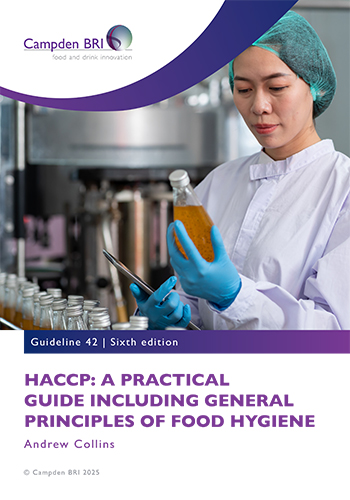
Get the new Guideline 42 today! For a holistic approach and the latest developments in HACCP and food safety management, use ‘Guideline 42 – HACCP: A Practical Guide including General Principles of Food Hygiene’
Six key elements of an effective HACCP system
1. Prerequisites
The role and importance of prerequisite programmes (PRPs) within food safety management systems cannot be overstated. According to Codex General Principles of Food Hygiene, the correct application of good hygiene practices (GHPs) may be adequate to control certain food safety hazards, or even all food safety hazards in some circumstances. This approach has always been in the preamble of Regulation (EU) 852/2004, recital 15.
Codex also states that in situations where GHPs alone are not sufficient to ensure food safety, and where hazard analysis identifies significant hazards that are not adequately controlled by GHPs, these hazards must be specifically addressed within the HACCP plan.
It is therefore essential for businesses to determine which food safety hazards are being effectively managed by the prerequisite programme.
Additionally, businesses should consider the potential sources and vectors that could lead to the food being unsafe by ensuring that all potential food safety hazards are properly understood and controlled.
In the new edition of Guideline 42, we have introduced an approach similar to the tabular method that most businesses use when writing the HACCP plan.
This approach is effective in getting food business operators (FBOs) to consider:
- The food safety hazards that GHPs/PRPs are managing;
- The activities that manage the food safety hazard;
- How the PRPs/GHPs are monitored, and;
- Appropriate corrective actions and verification activities.
2. Hazard analysis – and applying HACCP methodology beyond food safety
Many food businesses, after identifying and mapping all their food safety hazards, proceed with a qualitative or semi-qualitative risk assessment using a risk matrix. The sixth edition of Guideline 42 introduces enhanced guidance for conducting hazard analysis and a 4x4 risk matrix has been adopted (replacing the 3x3 matrix from earlier editions to give more clarity in the decision-making process).
The criteria set out in the new risk matrix are clear and distinct, which assists food businesses in reaching agreement on the outcome of their evaluations.
While the primary focus of HACCP systems is to ensure food safety for the consumer, it is important to recognise that similar methodologies can be applied to address other types of business risks. These risks may include supply chain vulnerabilities, incidents of food fraud, risks to brand reputation, and general operational challenges. In each scenario, it is essential that the criteria and methods used are carefully calibrated and tailored to suit the specific context in which they are implemented.
3. Categorisation of control measures
Following the hazard analysis, it is essential to address all significant food safety hazards that have been identified. To manage these food safety hazards effectively, control measures must be validated. One of the key considerations is determining whether a control measure is critical for food safety.
The control measures may be grouped into the following categories:
- Preventative controls: These are synonymous with prerequisite programmes (PRPs) and Good Manufacturing Practices (GMP). They focus on preventing hazards from occurring within the production process.
- Preparedness or mitigation programmes: These include activities such as traceability, control of non-conforming products, rework, product recall and crisis management. Such programmes are designed to prepare for and mitigate the impact of hazards should they arise.
- Hazard analysis plan and control points: This category covers critical control points (CCPs) and enhanced prerequisite programmes (EPRPs), which are measures applied to control specific hazards at identified points in the process.
The updated Guideline 42 provides a logical explanation for using tools (such as its newly developed decision tree) to categorise the control measures, enabling businesses to determine the criticality of each measure and ensure that all food safety hazards are effectively managed.
4. Monitoring controls and implementing corrective actions
All controls, including prerequisites, must be subject to effective monitoring to ensure that any deviations from established parameters are promptly detected. Should a control fail or a parameter exceed its defined limit, corrective actions must be implemented without delay. These corrective actions serve as essential mitigations, designed specifically to prevent unsafe food products from reaching the marketplace.
Guideline 42 sets out the primary objectives of such corrective actions, emphasising the critical role of PRPs in restoring control over the process and preventing the recurrence of identified issues.
The effective application of PRPs is fundamental to regaining control and maintaining the safety and integrity of food products within the supply chain.
It is also important to recognise the limitations of relying solely on corrective actions after control parameters have exceeded established limits, such an approach may fail to address incremental changes or trends in these parameters, which, over time, could undermine food safety. Therefore, ongoing monitoring and timely intervention in response to gradual changes are essential to uphold effective risk management and ensure the continued safety of food products.
5. Risk management techniques and their integration with HACCP
ISO 31010:2019 details risk management techniques businesses use to address hazards. In food safety management, HACCP prioritizes controlling risks during production rather than relying solely on end-product testing. Its main principle is identifying and controlling potential food safety hazards – especially those introduced by human actions – at each stage of production. This proactive system reduces the chance of compromised safety. Implementing HACCP entails systematically identifying food safety hazards, assessing their risks, understanding their significance, and applying targeted controls.
In certain instances, it may be necessary to integrate HACCP with additional risk management tools to provide more comprehensive oversight and input into the overall management of risk.
Other approaches include risk matrices and qualitative risk assessments (such as toxicological risk assessments). Another approach that has been introduced in the new sixth edition of Guideline 42 is BowTie; a barrier risk management methodology that has been widely used in other industries.
6. Resilience and assessing maturity
According to BS 65000:2022, resilience is defined as the capability of an organisation to be prepared for disruption, adapt to changing conditions, and thrive in a dynamic environment. This notion not only encompasses the ability to respond to major disruptions but also extends to incremental changes that occur over time.
By developing resilience, organisations can ensure their systems are robust and flexible enough to maintain operations and food safety standards in the face of evolving challenges.
Businesses that operate systems designed to enable effective responses to both anticipated and unforeseen changes are more likely to survive and prosper. Ensuring adaptability within food safety management processes allows organisations to continuously meet regulatory requirements and consumer expectations, strengthening their overall position in the market.
For further insight into organisational resilience, see our ‘What is organisational resilience?’ blog.
Maturity modelling serves as a valuable tool for organisations aiming to demonstrate their food safety management system’s capacity to manage threats and deviations effectively. Through this approach, businesses can systematically assess and illustrate how their processes respond to potential risks and challenges.
It is crucial for organisations to ensure that the maturity assessment process is carried out with thorough documentation, capturing both the methodology used and the results obtained. Comprehensive records help validate the effectiveness of the system and provide a clear basis for continuous improvement.
Achieving a high level of maturity assessment within a food business requires the implementation of a comprehensive food safety management system. Such a system must place equal emphasis on the importance of prerequisite programmes (PRPs), enhanced prerequisite programmes (EPRPs), and critical control points (CCPs). By maintaining a balanced focus across these elements, organisations can demonstrate the robustness and effectiveness of their food safety management, supporting continuous improvement and ensuring sustained compliance.
Expert guidance, tailored to your business – consultancy and risk management support
We have published practical guidance on HACCP since 1987 and, over the years, have become an authority in this field. Leading updates to guidance include our 2009 introduction of the five-question decision tree, with the question about the role of prerequisites managing food safety hazards, which was a gamechanger.
The sixth edition of our Guideline 42 (HACCP: A Practical Guide) publication is a widely used practical guide to the development, implementation and maintenance of food safety management systems for food production. Building on the strength of our 2015 edition, the completely revised sixth edition incorporates a more holistic approach and reflects the latest developments in HACCP and food safety management.
To further support your needs, we also provide a wide range of advice and consultancy services. These include support with the planning, development, implementation, validation and verification of effective HACCP and food safety management plans.
When it comes to risk management, we offer consultative expertise in risk assessment / management / communication and provide support with incident management. We help clients develop robust risk management programmes that proactively identify potential adverse impacts and implement strategies to reduce uncertainty and enhance resilience.
Through this risk consultancy, we help food businesses boost food safety culture, have full risk visibility, and achieve a holistic end-to end approach to risk management.

About Andrew Collins
Andrew joined Campden BRI at the beginning of 2009. With over 30-years’ experience in a wide range of food businesses (including catering), his current role focuses on consultancy work with the holistic and practical application of food safety management including the role of HACCP and good hygiene practices.
He is a certified BowTie practitioner, and is one of the few food safety experts globally using BowTie methodology – a barrier, risk-based thinking approach to risk management in the food businesses. This approach enables businesses to build holistic, resilient and adaptive systems in a rapidly changing environment.
Andrew also works on supply chain management, agriculture and water use, animal feed and traceability. Plus, he’s part of the team that manages hygiene and allergen management.
Guideline 42 – 6th edition
HACCP: A Practical Guide including General Principles of Food Hygiene
A widely used practical guide to the development, implementation and use of HACCP systems for food production.
How can we help you?
If you’d like to find out how we can help with your HACCP needs, contact our support team to find out how we can help.