

Struggling with shelf-life? How to set, validate and extend it with confidence
25 June 2026 | Jo Baker-Perret, Technical Manager
The shelf-life of a food or beverage product is the time that it remains both safe to consume and of acceptable quality (when stored and handled under the recommended conditions). This means that it still fulfils its sensory, chemical, physical, nutritional and microbiological requirements.
Understanding the shelf-life of your products is essential in assuring their safety and quality, and maintaining consumer confidence.
Setting the shelf-life of food and drink products
The shelf-life setting steps that may be used for a new product, changed product or shelf-life extension project are:
- Establish product parameters (for example, formulation, processing/packing method, packaging, storage conditions).
- Check the shelf-life related legislation and guidance in place in the countries of manufacture and sale.
- Check which microorganisms may grow and limit the shelf-life of the product (spoilage microorganisms and pathogens).
- Determine whether the microorganism(s) identified in Step 3 may be of concern regarding growth in the product (such as pathogens in excess of the regulatory limit or other microorganisms at levels that affect quality). To do this may require the use of one or more of the following: expert knowledge, predictive microbiology, historic data, HACCP and/or microbiological risk assessment, challenge testing, shelf-life testing.
- Conduct quality shelf-life testing - sensory, physical, chemical, nutrition.
- Set the final shelf-life based on results of steps 4 and 5 and relevant legislation. Always consider any abuse of the product by the consumer when setting final shelf-life. Consider if there is a need to set an opened shelf-life and, if so, obtain objective evidence to determine what this is.
- Ongoing review of relevant legislation and guidance, HACCP, production area environmental testing, final product testing (at time of production and at end of life) and consumer complaints. [outcomes may trigger return to step 1/2/3]
- Any product development activities. [return to step 1]
Step 1 is the ideal opportunity to design your product with a particular shelf-life in mind, as the formulation, processing / packing method and storage conditions all impact the feasible shelf-life range for your product. Understanding the detail of what can influence shelf-life may enable you to leverage these factors to maximise your product’s shelf-life.
Shelf-life is best considered and influenced within product design / early in product development, however there are still strategies that you may adopt to extend your product’s shelf-life through reformulation / innovation / renovation of your product’s recipe, processing, packing, packaging and storage.
Safe shelf-life and quality shelf-life – what is your limiting factor?
Broadly, the steps involved in setting a food / drink product shelf-life are:
Future product development
- any product development activities (return to step 1)
Determining whether the growth of any microorganism may limit shelf-life
For products within which microorganisms can survive and grow, their impact may be the limiting factor for shelf-life.
It must be established whether a product can support the growth of pathogens or the formation of microbial toxins.
Factors affecting a product’s microbiological shelf-life include:
- Raw material quality
- Heat process / ‘kill step’, where applicable
- Product formulation – pH (acidity), water activity, preservatives
- Packaging, including gas atmosphere
- Temperature and storage conditions (commercial production, distribution, warehousing, retail storage / sale, consumer handling)
- Environmental hygiene of production area
Understanding the factors that support and limit shelf-life length is one thing – but how do you assign a shelf-life that you know, from a microbiological perspective, will prevent product spoilage and keep consumers safe?
There are four commonly used methods to determine the life of a product with respect to its microbiology, and these may be used singly or in combination by manufacturers to give an accurate view of product life. These methods are:
- Predictive microbiology: The computer simulation of the growth of microorganisms in food and beverage products.
- Use of historical data: Many companies hold a large amount of historical microbiological testing data on the products that they produce. If a new product has very similar constituents, processing conditions, packaging and storage conditions to an existing product, then it may be that the shelf-life will be similar.
- Microbiological quality shelf-life testing: Generally relates to products where pathogens are not expected to be present or to be able to survive / grow. It is concerned with the survival and growth of naturally occurring microorganisms, as well as changes to other quality parameters.
- Challenge testing: Deliberate inoculation (contaminating the product with a known level of a particular microorganism) of your product with relevant microorganism(s) and then monitoring the levels over the intended life. It is a laboratory simulation of what can happen to a food or beverage product, during distribution and subsequent handling, if it were to be contaminated with a microorganism.
The methods selected depend on the level of risk of growth of pathogens and spoilage organisms in the product.
Determining when quality limits shelf-life
Microbial growth is not the only factor that can limit a product’s shelf-life. Where microbiological shelf-life has been confirmed, it is also necessary to ensure that the quality parameters of the product will remain satisfactory within the safe life.
Many product parameters can change when a food or beverage product is stored. Some changes will be considered a quality defect (such as colour change) and others are an indicator / risk or cause for such defects – such as pH change (which can change the ability of spoilage microorganisms to grow) or lipid oxidation (which can cause off flavours).
Aside from microbial spoilage, factors limiting quality shelf-life can include moisture loss or gain, staling, rancidity, changes to appearance, texture, odour and flavour, the uptake / development of a flavour taint and changes in nutritional levels.
Data from assessing sensory attributes, as well as other quality parameters and indicators, should be used to make an informed commercial decision regarding product shelf-life. Here the assessment being made is of determining how long the product remains at the quality that the consumer would expect. Sensory attributes typically assessed during quality shelf-life testing are appearance (including colour), odour, flavour, texture and mouthfeel. As with all quality parameters, it is best practice for a degree of ‘buffer’ to be included when factoring this into setting the shelf-life to reduce the incidence of complaints and account for imperfect storage conditions.

The aim of conducting sensory assessments over shelf-life is to monitor and record the changes that occur in the sensory attributes outlined above. This can be done by sensory assessors objectively describing the attributes and their intensities at each assessment interval of the shelf-life, and using this to identify when changes occur and the magnitude of that change.
For any physical and chemical parameters measured for quality shelf-life testing (such as pH, texture / viscosity and density) it is important to understand what effects these measured parameters have on shelf-life (and therefore why that test is being done), and to have set objective acceptability limits for each of them before undertaking testing. Much of this should have already been determined earlier in the product development process, as part of writing the product specification, but it is important to understand how this relates to interpreting the results of your quality shelf-life testing and the troubleshooting of any unsatisfactory results.
FREE webinar - Shelf-life confidence Webinar: Design it, prove it, improve it
This webinar, we will explore the full cycle of the shelf-life management system. We will share insights to help you design products to achieve the right shelf-life, validate it with data, and diagnose and fix failures when they occur.

Where relevant, nutritional analysis needs to be conducted to ensure that the product and its claims are compliant to relevant legislation and guidance at all stages of its saleable life. An understanding of the stability of your ingredients, product formulation and the nutrients / components within are important for designing a testing plan and ensuring compliance with relevant labelling / nutritional legislation and guidance for the markets within which your product is sold.
Extending shelf-life
Assigning the correct shelf-life is paramount for the commercial success of a new product. Any subsequent changes to formulation, packaging, manufacturing, distribution and storage should trigger a review of both the HACCP plan and the shelf-life of the product, both of which may be influenced by one or more of these factors.
Any shelf-life extension project must be carefully considered to ensure that food safety and quality are not compromised.
For many products, one of the first things to consider in shelf-life extension is how to reduce the risk of microbial growth. This can be done by reducing microbial levels or slowing growth rates of the microorganisms in the product. There are a number of ways in which this can be achieved, the majority of which are already well established.
Shelf-life is best considered and influenced within product design / early in product development. However, reviewing the way your product is made, processed, packaged and stored can also identify opportunities to influence and extend the shelf-life of an existing product.
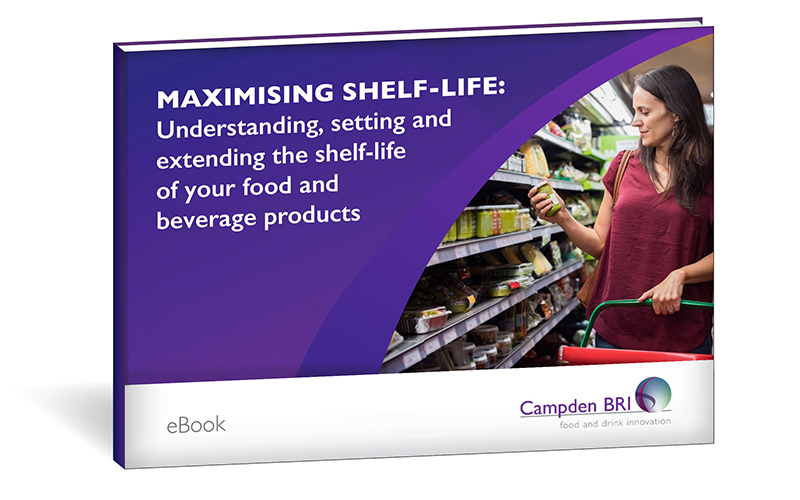
Download the complete Maximising Shelf-life eBook, for free, to unlock the tools for measuring and maximising the shelf-life of your food and drink products whilst ensuring their safety and quality.
Your partner for designing, validating and troubleshooting food and drink shelf-life
Considerable expertise and experience are needed to ensure all necessary considerations are included in the setting or extension of a product’s shelf-life, to protect product safety, quality and legal compliance.
Renowned as an independent expert in the food and drink industry, we have more than 200 scientists and technical experts collaborating on a wide range of projects every day. Our teams work together across formulation, processing, microbiology and quality to deliver a joined-up approach to shelf-life, from design through to troubleshooting.
With all the expertise and practical support you need under one roof, we can help with:
- Trials to verify / validate shelf-life
- Accelerated shelf-life testing
- Shelf-life design in new product development
- Shelf-life extension
- Troubleshooting/investigation of shelf-life failures
We work extensively helping manufacturers to determine the best date mark type to use, maximise shelf-life so that products are economic to produce and less likely to become waste, and ensure the safety and quality of these products for consumers.

About Jo Baker-Perrett
After graduating from his master’s degree in chemistry from the University of Sheffield in 2014, Jo worked in education before joining us in 2016. Since then, Jo has worked in the bakery department, and then in Food and Drink Microstructure, after which he started managing this section, which is mainly focused on physical characterisation and ingredient functionality.
Jo has published various Campden BRI research reports and trade press articles, as well as producing regular food industry blogs for our website.
How can we help?
If you’d like support with designing, validating and troubleshooting food and drink shelf-life, get in touch.
More on shelf life
Your one-stop shop for food and drink shelf-life: From product development and validation to troubleshooting and extension.