
Using small-scale bubbles for cleaning
Dean Burfoot, Special Project Manager
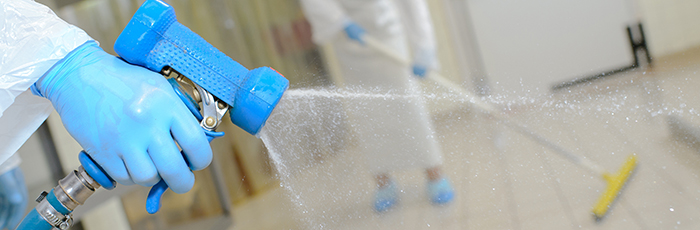
Many foods and food contact surfaces are washed or cleaned by either spray or deluge of water. The costs of water and its treatment are increasing so methods to reduce water usage are required by industry. Modifying the properties of the water by introducing air into the liquid provides additional cleaning forces. Tension at the surface of each bubble resists forces applied to the bubble and it is this action that leads to an additional cleaning effect of the water/air mixture.
Dean Burfoot discusses research into the use of small-scale bubbles for cleaning surfaces in our latest video.
You may also be interested in
Transcript
We've been looking at putting bubbles into the water used for cleaning and washing, the idea is that the bubbles have a cleaning action. There are many types of bubble generator, the ones that we've used are basically a Venturi with a recirculation zone. The Venturi has an air line coming into it and you can adjust the amount of air that goes into the Venturi and when you do that it changes the size of the bubbles so you can have nanoscale bubbles, micron scale bubbles or millimetre sized bubbles, which tend to create a jacuzzi sort of effect.
We've looked at the removal of biofilms from stainless steel coupons or stainless steel samples. The sort of starting point when you put a biofilm on, you've got a count microbe counter around about ten to the six, ten to the seven, ten to the eight organisms. When you then apply water with no bubbles that reduces by about one log, we then use small bubbles and it reduces further or if you use large bubbles you can get even greater effect. We've also looked at cooking on ready meal on to stainless steel and then look at the removal by using bubbles in water in that case, again, the bubbles give an improvement in the cleaning effect that's achieved and that's if we put either the nozzle underneath the water for the cleaning or you use the nozzle just as a spray into air, either way putting bubbles in the water improves the cleaning action. We've also looked at the removal a biofilm that's being grown inside a pipe and again by introducing bubbles into the water then we get an improvement in cleaning.