

Thermal process validation in food and drinks: Why process modelling matters – and how to choose the right method
10 July 2026 | Yi Wang, Process Engineer
Mathematical modelling and simulation are increasingly used throughout the process industries, including food and drink manufacturing, to develop, study and improve their processes and products. Process modelling simulations enable the effects of process condition changes to be evaluated and optimised computationally, prior to experimental thermal process validation, saving on costly process trials.
Here we look at how thermal process modelling works, how it benefits food and beverage manufacturers, and the limitations and benefits of the different modelling approaches available for food and beverage thermal processes.
Importance and benefits of thermal process modelling
Practical thermal process validation of food and beverage decontamination processes / kill steps typically involves using temperature data loggers to physically measure both cooker environmental temperature and product temperature to verify that the required microbiological kills, quantified by lethality with a unit of minutes, has been achieved. While practical validation through physical measurements is robust, it is not feasible to use this approach to explore all possible processing scenarios and process deviations that may need to be investigated.
Thermal process requirements vary by product, cooker type and lethality target. For example, a 60 minutes retort process may require at sterilisation temperature of 121°C to achieve a target product lethality of F06. However, what if we want to reduce the sterilisation temperature from 121°C to 120°C, or shorten the process from 60 minutes to 50 minutes, and check if the product still achieves the target lethality of F06? Similarly, what if the processing temperature drops to 110°C for 5 minutes due to a power cut(?), in which case we may need to assess if the batch of products processed by this unusual thermal process still reaches the required lethality target of F06.
Practical investigation through trial-and-error testing can be expensive and time-consuming
Because these processes often involve long cycle times, high temperatures, high pressures, significant steam usage, numerous data loggers, and extensive data analysis, practical investigation and optimisation through trial-and-error testing can be expensive and time-consuming. In addition, during process deviations, such as a power cut, there would be no physical data loggers present in the cooker to capture the actual product temperature response.
Whilst identifying the optimum combination of processing temperature, process time, initial product temperature and other process parameters through physical trials alone can require substantial resources, modelling can provide a much more efficient way to predict product temperature response and lethality across a wide range of process conditions, including process deviations. This helps identify process settings that achieve the target lethality while avoiding unnecessary overprocessing and product waste.
Rapid, cost-effective thermal process investigation and optimisation that would be impractical and expensive through plant trials alone
Modelling benefits at a glance:
- Evaluate hundreds of process scenarios in minutes
- Enable rapid, cost-effective process development and optimisation
- Assess process deviations without physical data-logger measurements
- Support quality and safety control decisions
Selecting the right process modelling approach
Commercially available modelling approaches for food and drink product and process generally fall into three categories:
- 1. The Ball method was developed in the 1920s, before modern computing was available. It relies on a combination of empirical factors and theoretical approximations to estimate the product temperature profile and resulting lethality under a given cooker temperature profile. In effect, it provides an approximate solution to the heat transfer problem between the cooker environment and the thermal centre of the product.
- A key advantage of the Ball method is its simplicity and speed. It can quickly estimate product lethality against a target using a limited set of inputs, such as processing temperature, process time, initial product temperature, heating rate (f_h) and lag factor (j_h). However, its application is largely limited to relatively simple and linear process profiles. For example, it is well suited to cycles with a single constant processing temperature during the sterilisation or pasteurisation phase, together with a straightforward come-up phase and cooling phase. On the other hand, it is much less suitable for modelling process deviations, such as temperature drops during the holding phase, or more complex non-linear process profiles, such as stepwise temperature changes during come-up, sterilisation or cooling.
- Ball method overview:
-
- Simplicity and speed
- Largely limited to relatively simple and linear process profiles
- Less suitable for modelling more complex non-linear process profiles or process deviations
- 2. The finite difference method takes a more detailed numerical approach. It begins by approximating the product and container geometry as a discretised domain made up of small nodes. The heat transfer equations are then solved numerically at each node and at each time step to predict the temperature distribution throughout the product over the course of the thermal process. From this, the temperature history at the critical location can be used to calculate lethality.
- For improved predictive performance, the modelled product temperature profile is typically fitted to the actual product temperature profile and heating-rate (f_h) measured during practical trials, using empirical correction factors. Once good agreement is achieved between the predicted and measured temperature profiles, the model can be considered representative of product behaviour in that specific cooker under those defined conditions. The validated model can then be used to explore alternative process conditions, such as different cooker temperature profiles or initial product temperatures, to identify settings that achieve the required lethality.
- Compared with the Ball method, the finite difference method can provide greater flexibility and accuracy because it provides the product temperature profile from the theoretical solution of the heat transfer equation rather than from a linearized approximation. It also allows different heating and cooling rates to be assigned to different phases of the process, enabling a more realistic simulation of actual heating conditions. This makes it particularly useful for modelling more complex thermal processes, including broken-heating products and processes involving non-linear temperature behaviour.
- Another important advantage is its ability to investigate process deviations. For example, the cooker temperature profile can be modified to include a temporary temperature drop, and the model can then predict the corresponding effect on product temperature and lethality, which is not something the Ball method handles well.
- Finite difference method overview:
-
- Greater flexibility and accuracy (vs Ball method)
- More realistic simulation of actual heating process conditions
- Useful for modelling more complex thermal processes, including broken-heating products and non-linear temperature behaviour and process deviations
- Practical heat penetration data upload is required before a model can be created
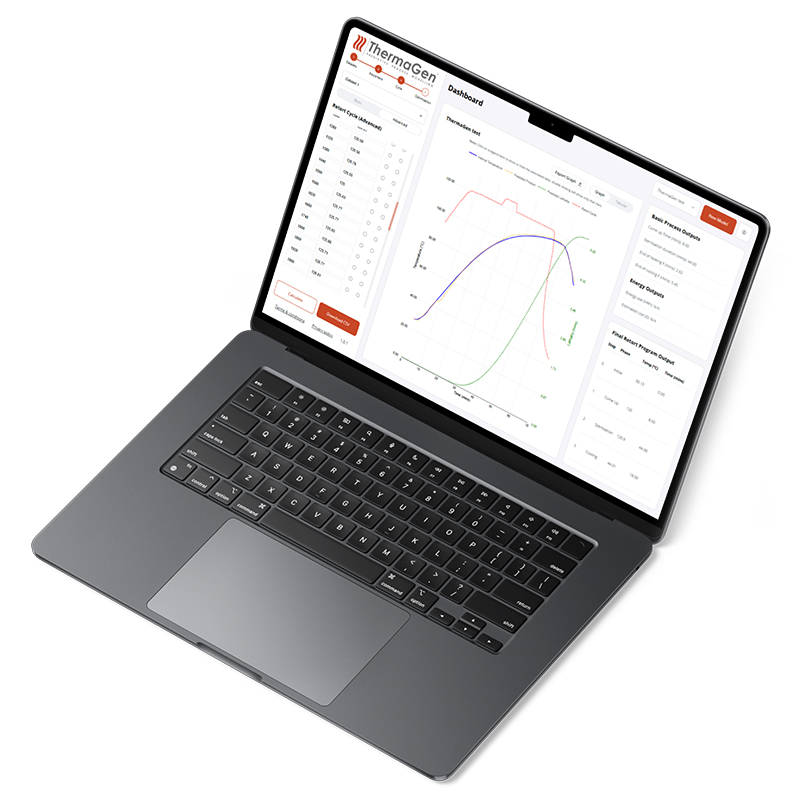
- Recent development of modern software has made these modelling approaches more accessible in practice. For example, our ThermaGen™ software, released in 2025, provides both Ball method and finite difference method simulations, allowing users to compare the two approaches side by side for the same thermal process. It also includes a range of advanced features, such as the ability to define multiple heating and cooling rates to better fit real process behaviour and model more complex broken-heating products. In addition, the software can estimate the energy consumption and cost associated with a thermal process.
- 3. Finite element method simulations provide another modelling approach for food and drink thermal processes. Commercial finite element software packages are available for this purpose, including COMSOL Multiphysics and ANSYS.
- In finite element simulation software such as COMSOL, the model must first be built using defined product geometry, packaging geometry, material thermophysical properties, and appropriate boundary and initial conditions. As a result, finite element modelling has a high potential ceiling in terms of simulation accuracy. However, it also has a relatively low floor, because the model outcome depends heavily on the quality and correctness of the inputs. With many influential parameters to define, there is greater scope for modelling errors, and inaccurate assumptions can lead to inaccurate results.
- In principle, if the model is set up to represent the real product and cooker process closely, finite element simulation can produce results that are highly representative of real-world thermal behaviour. However, developing such a detailed and reliable model takes time and specialist expertise. This means the initial investment is typically higher, and the approach is generally less flexible for routine industrial use than the finite difference method or the Ball method.
- Finite element method simulations overview:
-
- High potential ceiling in terms of simulation accuracy
- Can produce results that are highly representative of real-world thermal behaviour
- Can provide strong basis for predicting effects of product and process changes
- Accuracy depends heavily on the quality and correctness of the inputs (greater scope for modelling errors; inaccurate assumptions can lead to inaccurate results)
- Developing such a detailed and reliable model takes time and specialist expertise
- Initial investment typically higher
- Less flexible for routine industrial use
- Finite element simulation is therefore best suited to users who have the resources to develop a dedicated model for each specific product and process. Once validated, such models can provide a strong basis for predicting the effects of future process changes.
Overall, of the three methods explored here, finite difference modelling offers a strong balance of accuracy, flexibility and practicality for thermal process modelling. It is more capable than the Ball method for complex, non-linear processes, broken-heating products and process deviations, while being more accessible and efficient for routine industrial use than finite element modelling.
ThermaGen™ is based on the finite difference method and makes it easy to apply in practice. By providing both finite difference and Ball method calculations, supporting multiple heating and cooling rates, modelling complex process behaviour and estimating energy use and cost, ThermaGen™ provides a practical way to improve thermal process efficiency and safety.
ThermaGen™ - The next generation of thermal processing software
Save time and money with ThermaGen™ a cloud-based application providing predictive calculation capability for those working with industrial thermal processing of food and beverage products.
How we can help – ThermaGen™
If you would like to learn how ThermaGen™ can support the prediction of product temperature and lethality, optimise cooker programmes and process cycles, and inform safety decisions on the release of batches affected by process deviations, get in touch for an introduction to the ThermaGen™ software.
This software is part of our broader manufacturing and processing support, which includes consultancy to review thermal processes and non-thermal processes, optimise them and aid troubleshooting. We also provide support with feasibility studies and validation trials for new processing technologies.
Alongside this, our experts run a variety of scheduled thermal processing training courses, which include generalised or sector specific content, online or face-to-face sessions.

About Yi Wang
Yi Wang joined Campden BRI in 2024 as a Process Engineer. In his first year, Yi focused on developing ThermaGen, a thermal process modelling software that predicts in-container product temperature profiles and lethality in food and beverage applications using the finite difference method. He has also played a key role in supporting practical thermal process validation projects at clients’ production sites.
Before joining Campden BRI, Yi completed a PhD in Mechanical Engineering from Texas A&M University, following an MSc in Mechanical Engineering from Stanford University. He then worked as a Postdoctoral Research Fellow at the Birmingham Centre for Energy Storage at the University of Birmingham.
Yi specialises in heat transfer, fluid flow, and thermodynamics. His expertise includes internal flow and multiphase heat transfer, cryogenic heat transfer, electronics thermal management, and thermochemical energy storage. He has a strong research record, having led and contributed to projects funded by the US N ational Science Foundation (NSF) and the UK Engineering and Physical Sciences Research Council (EPSRC). His work has been widely published in leading international journals.
Transform your thermal processing
Are costly trial runs, uncertain process deviations or process optimisation and modelling challenges holding you back? Help is at hand with ThermaGen™
Process validation support
For help with robust process validation protocols, accurate conclusions and clear outcomes, get in touch.