


RCA in the food and drink industry: How to get root cause analysis right
11 May 2026 | Louise Harris, Safety and Quality Specialist, and Richard Leathers, Global Quality Lead
Finding and addressing the true root cause of a food or drink non-conformance incident is incredibly important to prevent reoccurrence, but can be challenging to achieve in practice.
To complete root cause analysis (RCA) studies thoroughly there are various steps that need to be considered. If any part of the investigation is missed, the correction, prevention and continuous improvement you are trying to deliver can fall down.
RCA challenges
There are many challenges with completing thorough root cause analysis investigations, for example:
- Are you getting to the true causes, not just addressing symptoms of issues found?
- Do you complete investigations in a timely manner and with a suitable competent team of individuals with the right skills and knowledge?
- Is the investigation well documented outlining the RCA tools used?
- Are you ensuring there is shared learning in other areas of the business or with sister sites (for multi-site operations) when the outcomes of the investigation are addressed?
- Is adequate time and resource being dedicated to incident investigations – in particular, root cause analysis?
How to overcome RCA challenges
To ensure a robust and effective investigation, it essential to use the appropriate tools – for example, using ‘PEMPEM’ followed by ‘Five Whys’. We explain more in this section.
Finding the cause:
Once the scope of the RCA study has been determined, we need to dive into ‘thought showering’ what could have caused the issue. Many tools are available to help you do this – whether it’s; Fishbone / Ishikawa / PEMPEM (diagram below), Five Why’s, BowTie, Mindmap etc.
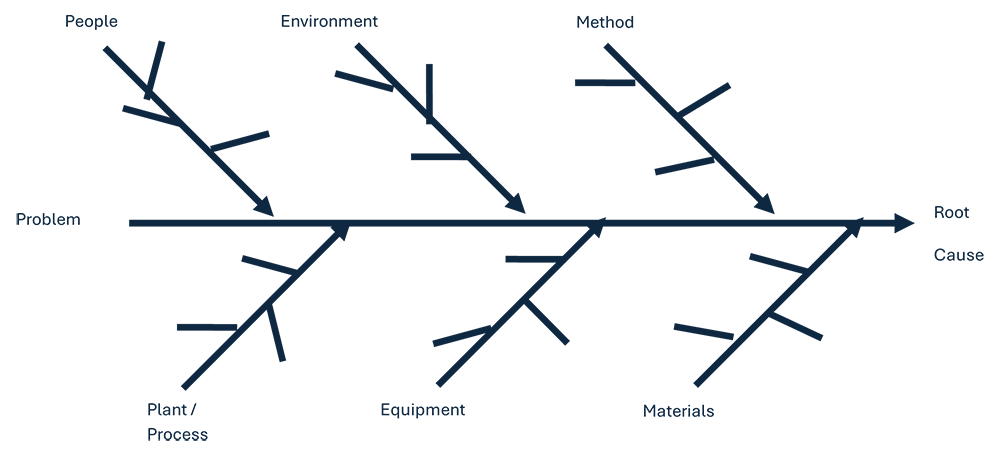
Using a PEMPEM diagram to document, expand and rationalise your thought showering can help ensure that all possible causes are captured. It also then aids identification of which potential causes are the most likely and significant.
From a tool such as PEMPEM, you then need to take what you believe to be the key / critical causes and analyse them further. For this, a tool such as ‘five whys’ can help you to understand the underlying causal factors behind the superficial issue.
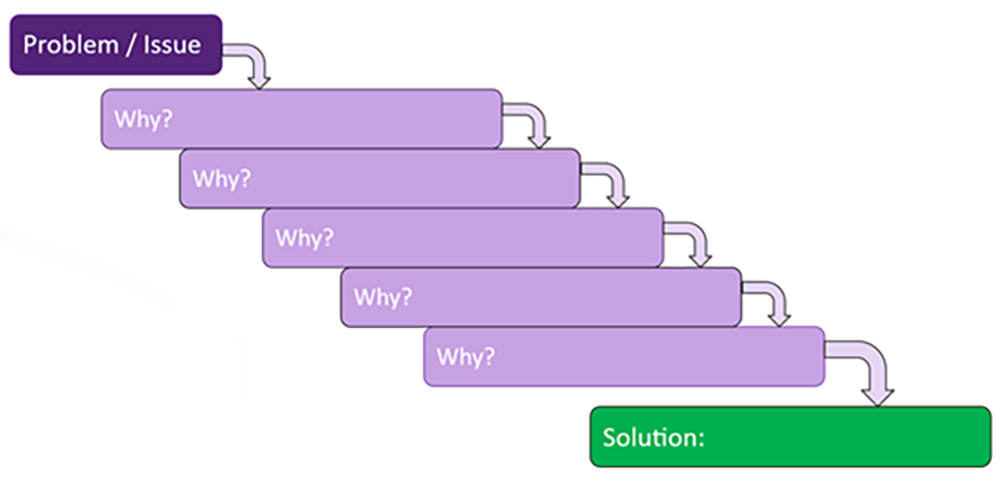
By asking “why” of the ‘cause’, you can then continue this stepwise until you get to the true root cause. It is important to expand the ‘five’ concept for as many steps as it takes to reach the true root of the issue.
Implementing and verifying the solution:
Once the cause(s) have been established, it is important to identify what you are going to put in place as corrective and preventative measures. It is not until these measures have been implemented and verified as working that we can ask the question of whether the solution is effective.
Checking the effectiveness of solutions can be an area that is missed on the close out of RCA investigations, due to tight timelines and using RCA as a tick box exercise (for satisfying customer or auditor requirements) rather than a true continuous improvement tool.
Effective RCA fits into a wider framework of improving food safety, quality, culture and operational excellence.
We link RCA to our corrective action or continuous improvement loop (see graphic below) for closing out non-conformances / non-conformance notes (NCNs).
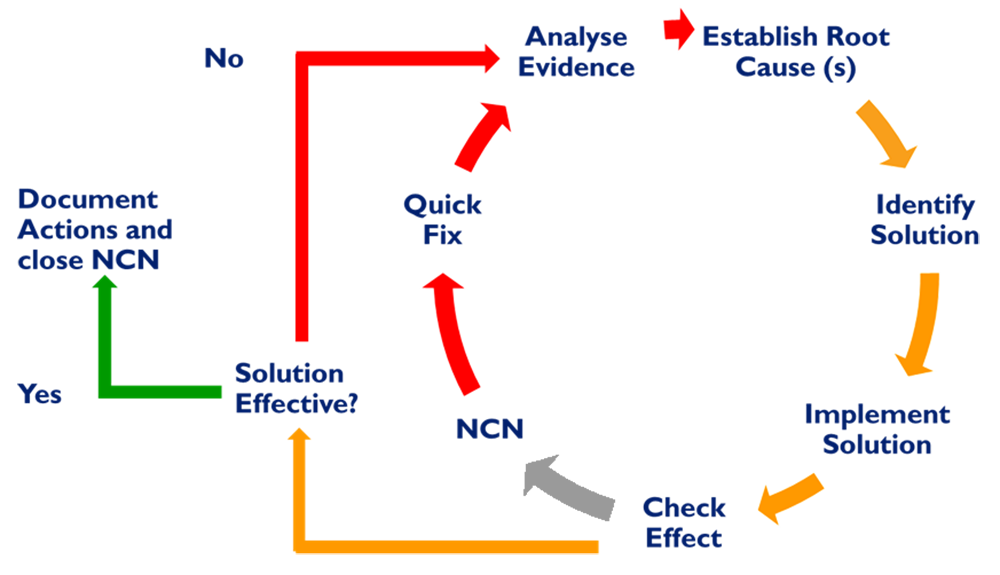
This keeps a focus on ensuring a true, effective, verified solution (based on a full understanding of the cause), rather than only a quick fix.
How we can help – true root cause, verified solutions, continuous improvement
We have a history of supporting our members, clients and the wider industry in this difficult area.
Download our FREE Supply Chain Resilience eBook today! Thrive in a changing environment by being prepared, agile and resilient.
We can assist with RCA including:
- RCA training and awareness for your team – tutor led (online or in person) or E-learning modules
- Risk management support
- Correction and corrective action review
- Crisis management advice during an incident
- Support following issues or incidents from an independent perspective
Our experts can help you to find the true root cause and determine the right corrective and preventive actions to ensure that you have cost effective solutions in place, and enable continuous improvement.
If you need guidance or support with RCA investigations, please get in touch.

About Richard Leathers
Richard Leathers joined Campden BRI in September 2011, and has worked in the food industry for 4 decades.
Richard started working with Dairy Crest and subsequently worked for both Heinz, Unilever, Best Foods and Kanes Foods. Working in the areas of HACCP and Quality Management Systems, Richard also has experience within the fresh produce sector, as well as analysis systems in the milling / baking areas, and is a BRCGS qualified lead auditor.
Richard has contributed to several publications and guidelines, including those for TACCP, VACCP and HACCP / Risk Evaluation and is also trained at advanced level by EHEDG (European Hygienic Engineering Design Group).
How can we help?
If your investigation could benefit from our RCA guidance and practical support, get in touch
Campden BRI Membership
Discover more about how you can benefit from a Campden BRI membership